Model Numbers, Decoded: The Letters After the Name
A TV's long model name is not gibberish — it is a short sentence about the TV, written in code: what kind of screen, how big, which series, and which year. Learn to read the sentence and two mysteries clear up at once — why the same-looking TV carries three different prices, and how to be sure the one in the store is the one you researched at home. The shelf's lesson Reading a Product Listing: What Is Real and What Is Sales Talk warns that the year hides inside the name; this lesson is the full decoder.
The shape of the sentence
Nearly every TV name follows the same order: screen family first, then the size in inches, then the series, then the year, then a tail of letters that covers region, tuner, stand, and store details. Three real examples, taken apart using each maker's own published decoding:
| Model | Read it piece by piece |
|---|---|
| Samsung QN65S95C | QN — a QLED-family set made for North America. 65 — 65 inches. S95 — the series (Samsung's OLED line). C — the 2023 model year; the next year's letter was D. |
| LG OLED55C3PUA | OLED — the screen kind, spelled out. 55 — 55 inches. C — the C series, LG's middle OLED line (B is plainer, G is fancier). 3 — the 2023 model year; the C4 is the year after. PUA — the American-version tail. |
| Sony XR-65A80L | XR — Sony's picture-processor name. 65 — 65 inches. A80 — the series; the A marks Sony's OLED line. L — the 2023 model year. |
| Vizio V555-J01 | V — the V-Series, Vizio's everyday line (M is the step up, P the flagship). 55 — 55 inches. The tail after the dash is a version code rather than a neat year letter — Vizio promises no tidy public year code, so the maker's page for the exact string is the referee. |
| TCL 55S455 | 55 — 55 inches; TCL puts the size first. S4 — the series (S3 is plainer, S5 fancier; the Q and QM lines are TCL's brighter tiers). The last 55 is a build and seller code — which is why two stores show near-twin strings for near-twin TVs. |
| Hisense 55U8K | 55 — 55 inches. U8 — the ULED series and its step on the ladder (U6 is the value step, U7 the middle). K — the model year: K marks the 2023 line, and the line after wears N. |
Notice what is not in the name: the pretty words on the store sign — the marketing nickname — can stay the same while the letters quietly change. The string is the truth; the nickname is the perfume.
Why the same-looking TV has three prices
Stores do not all sell the identical twin. Makers produce near-twin versions for different sellers: the core string matches — same screen, size, series, year — while the tail letters differ, and with them sometimes the stand, the remote, or a small feature. A warehouse store's version and a big-box store's version can sit side by side online at different prices and both be genuine. The habit that protects you: compare the core first (family, size, series, year), then look up the exact full string on the maker's own website and read its specification page before deciding the dearer one buys you anything real.
Laptops speak the same language, with different accents
A laptop's model string is built the same way — a family name, then digits that group into size and generation, then a tail for the exact build. Each maker runs its own code, so never decode one brand's digits using another brand's chart. What transfers is the habit: the full string is what the maker's support pages, parts lists, and warranty lookups ask for, and two laptops sharing a friendly name can be different model years inside.
- Dell (Inspiron, XPS): the digits do real work. In an Inspiron 15 3530, 15 is the screen size, the first 3 is the tier (3 the everyday line, 5 the middle, 7 the premium), and the last pair moves with the processor generation — a 3530 and a 3520 are near-twins a generation apart.
- HP (Pavilion, Envy, Spectre): family and screen size read plainly, but the long tail after the dash — a Pavilion 15's -eg or -eh letters — is a build code, not a year your eyes can decode. HP's support page reads it; that is what the support page is for.
- Lenovo (IdeaPad): the first number is the tier again — IdeaPad 3, 5, and 7 climb in that order — the next two digits are the screen size, and the tail letters hint at the chip family inside. Same habit, third accent.
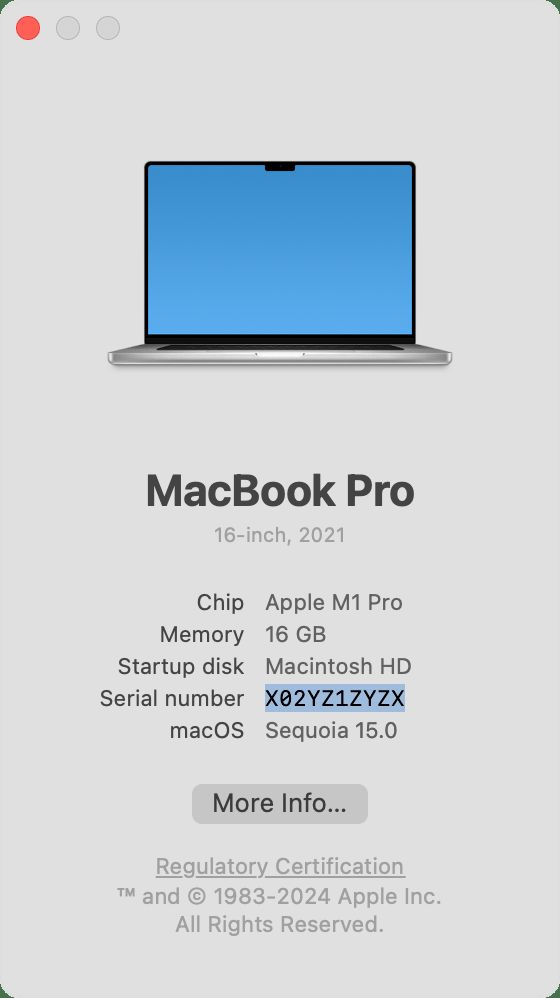
- Apple (MacBook): no string to decode at all. A MacBook names its chip — M1, M2, M3 — and its year, both printed plainly under the Apple menu in About This Mac. Apple is the one maker that simply tells you.
Model number or serial number? Two different stickers
Support lines ask for both, and they are not the same string. The model number names the kind of product — every V555-J01 ever made shares it, and it is the string this lesson decodes. The serial number names your one unit — no other TV on earth carries it, and it is the one a warranty lookup actually checks. Both live on the same label on the back of the set, usually a line or two apart. Reading the wrong one aloud costs a confused ten minutes; photographing the whole label into your home notebook ends the confusion for good.
The write-it-down habit
- Before you shop, write the full model string of the exact set you decided on — from the maker's website, not a store ad.
- In the store or online, match strings, not signs. One letter changed can mean last year's model — sometimes a fine bargain bought on purpose, never a bargain bought by accident.
- At home, copy the string off the box or the label on the back into your home notebook, next to the receipt. Future you — ordering a remote, a part, or help — will be handed the answer.
Words in this lesson
- Model number: the maker's exact code-name for one specific version of a product. No two different products share the full string.
- Series: a maker's step-ladder of models — higher series generally mean more features at a higher price, within the same year.
- Retailer variant: a near-twin version of a TV made for a particular seller, usually differing only in the tail letters and small details.
- Serial number: the unique code for your one individual unit — the string a warranty lookup checks, as opposed to the model number, which names the whole kind.
- Spec sheet: the maker's official list of a model's measurements and features — the page to trust over any store sign.
Straight 2 Work Tech, LLC — patient, plain-words tech help.
(813) 770-6082