TV Types Explained: OLED, Mini-LED & QLED
What the words on the box really mean, which type fits your room, and the one question to ask before you buy. Print the chart and take it to the store.
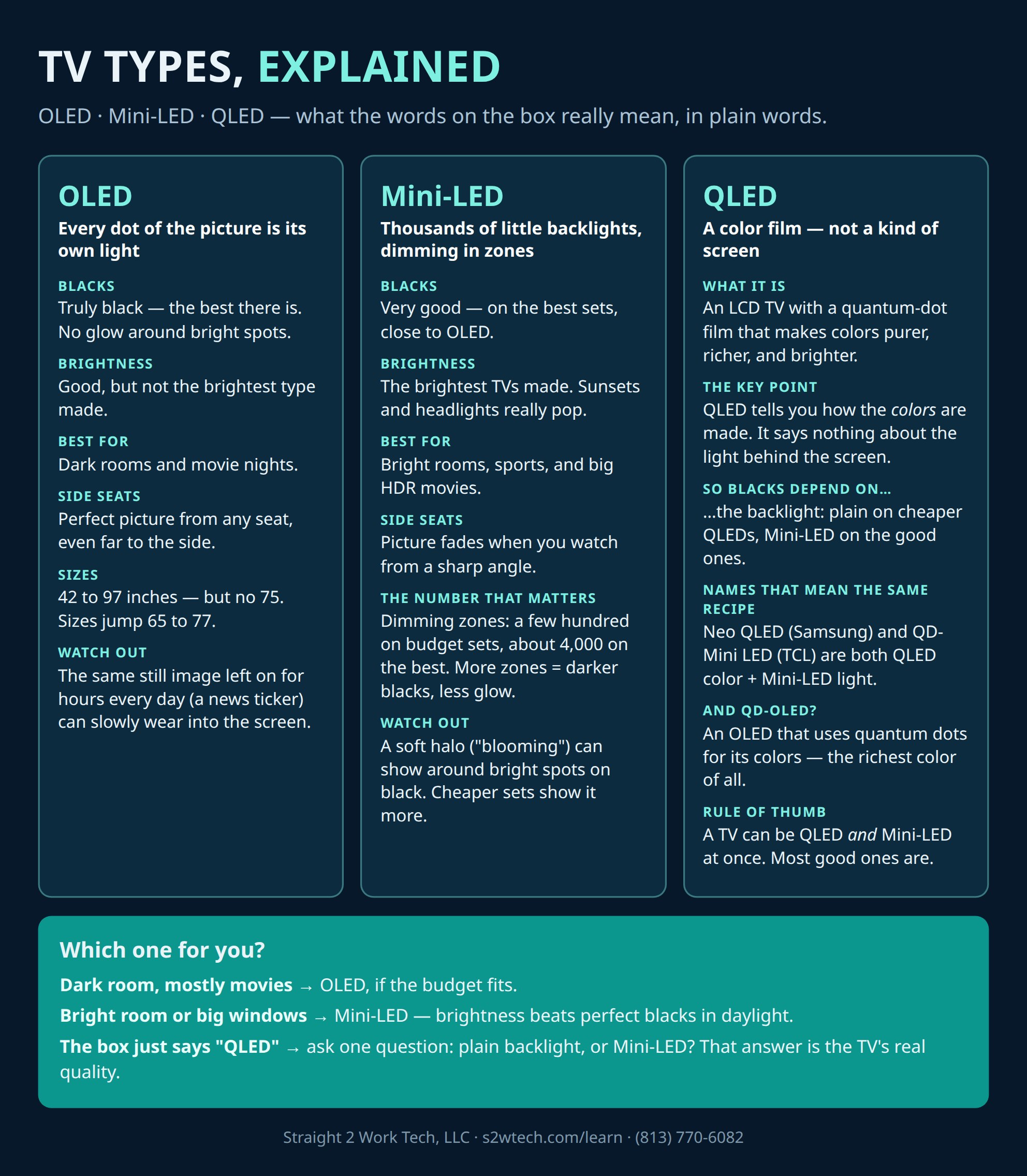
OLED — every dot makes its own light
A 4K screen has about 8 million dots (pixels). On an OLED, each one is its own tiny light: it can shine any color, or switch completely off. Off means truly black — no light at all. That is why OLED is the dark-room king: perfect blacks, no glow around bright spots, and a night sky in a movie looks real. The picture also looks the same from any seat, even far off to the side, and it changes fast, which gamers love.
The trade-offs: it does not get as bright as the best Mini-LEDs, so a sunny room can wash it out a little; it costs more; the sizes jump from 65 inches straight to 77 (there is no 75); and if the exact same still image sits on screen for many hours every day — a news ticker, a game score bar — it can slowly wear into the screen ("burn-in"). For normal mixed TV and movies, that risk is small, and today's sets have built-in protections against it.
Mini-LED — a backlight split into thousands of little zones
A Mini-LED TV is an LCD screen with a wall of tiny lights behind it. Instead of one big light for the whole picture, the lights are grouped into zones — hundreds on cheaper sets, up to about 4,000 on the best — and each zone dims or brightens to match its part of the picture. This is called "local dimming," and the zone count is the number that matters. More zones means dark areas get properly dark while bright areas blaze, so blacks come close to OLED.
Two things give it away: around a small bright object on a black screen you can still see a soft halo of light (that is "blooming" — fewer, bigger zones make it worse), and the picture fades when you watch from a sharp side angle on most models. What Mini-LED does better than anything: brightness — two to five times an OLED on the top sets — so it wins in bright rooms and makes sunsets, headlights, and explosions in HDR movies pop.
QLED — a color layer, not a kind of screen
This is the one the stores make confusing. QLED is a name Samsung started for an LCD TV that has a special color film, made of microscopic crystals called quantum dots, sitting in front of the backlight. The film turns the backlight's glow into purer, richer, brighter colors. Two things follow. First, "QLED" says how the colors are made — it says nothing about the backlight, so a QLED can have a plain backlight or a Mini-LED one. Second, you will see the names stacked: "QD-Mini LED" (TCL and Hisense) means quantum-dot color plus a Mini-LED backlight — most good TVs today are both. Samsung's "Neo QLED" is the same idea: its QLED with Mini-LED behind it. And "QD-OLED" (like the Samsung S90F) is an OLED that uses quantum dots to make its colors, which is why its colors are richer than a regular OLED's.
Today's picks
Dark room, 65 inch, under $1,000: LG B5 OLED — about $999 at the big stores. A real OLED right around a grand; the sweet spot.
Dark room, 65 inch, $1,000–$1,500: Samsung S90F QD-OLED — about $1,300 at the big stores. Brighter, richer color than the B5. Or the LG C5 OLED — about $1,500.
75 inch, under $1,000: TCL QM6K — about $800 at the big stores. Entry Mini-LED; good TV, blacks a little grayer.
75 inch, $1,000–$1,500: TCL QM8L — about $1,400 at the big stores, or the Hisense U8 — about $1,400 at the big stores. The most dimming control at this size; blacks closest to OLED. (There is no 75-inch OLED — sizes jump 65 to 77, and the 77s cost well over $1,500.)
Bright room: TCL QM8L 65 inch — about $1,000 at the big stores; Hisense U8 75 inch — about $1,400 at the big stores. Brightness and anti-glare beat perfect blacks in daylight.
Prices checked October 26, 2026; every pick above was re-checked November 12, 2026. These are sale prices and they move — check the price again the day you buy.
Shopping for a TV and want a hand picking or setting it up? Call (813) 770-6082 — Straight 2 Work Tech, LLC, Sun City Center, Florida.